
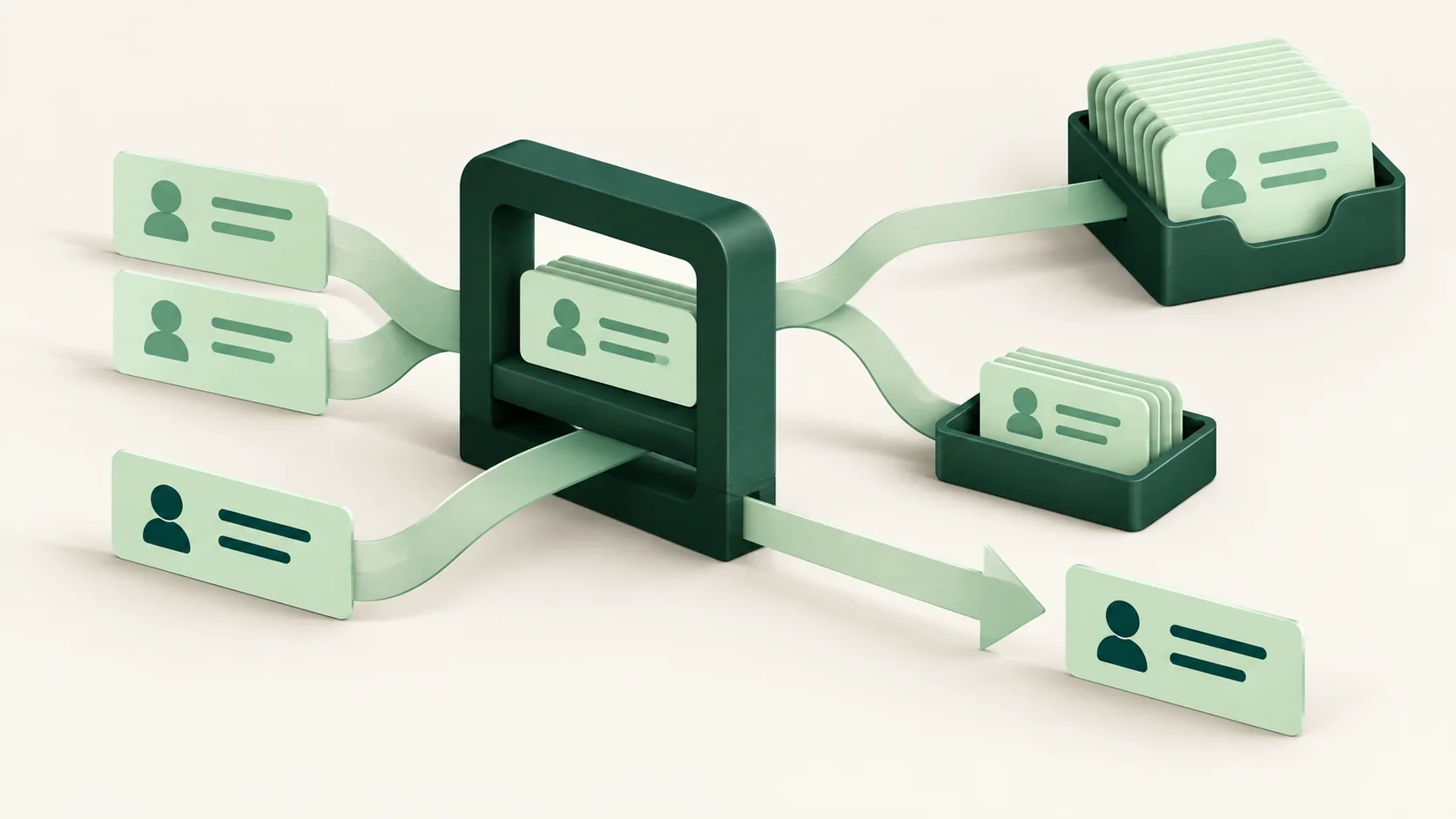
Two rows in your lead sheet do not necessarily mean someone submitted Contact Form 7 twice. The duplication may have happened in the browser, in a notification rule, or when an automation retried a request after a timeout. Deleting the second row immediately removes evidence and may hide a genuine second inquiry.
Start by identifying what repeated: a submission attempt, an email, an analytics event, or a destination record. This guide gives you a way to trace that boundary and design a repeatable recovery process. It applies to workflows sending CF7 inquiries to Notion, Airtable, a spreadsheet or a CRM through a separately configured integration.
Define the unit you want to count
A contact is a person or organization. An inquiry is a request from that contact. A delivery attempt is an effort to move that inquiry into another system. Those three objects need different identifiers. A returning customer can legitimately send two inquiries, while one inquiry can require several delivery attempts.
Write down the reporting rule before changing automation. For example: “Count each accepted inquiry once, retain every delivery attempt for diagnosis, and group inquiries under the same contact when appropriate.” An email address alone is a poor inquiry identifier because it collapses repeat business, shared mailboxes and follow-up requests into one record.
Find the first place where one becomes two
Use a synthetic test message with a recognizable reference, such as TEST-DUP-01, on a staging workflow whose email and destination records you control. Record the page, form, time zone and expected destination. Trace that reference through each available log instead of comparing daily totals from unrelated systems.
| Evidence | Likely investigation | What it does not establish |
|---|---|---|
| Two submission requests | Repeated user action or duplicate browser submission logic | Whether either request became a qualified lead |
| One request, two notifications | Mail configuration, recipients and forwarding rules | Two separate submissions |
| One source inquiry, two automation runs | Multiple workflows, repeated triggers or replay | A Contact Form 7 frontend defect |
| One workflow run, two destination records | Repeated create actions or downstream processing | Two visitors |
| One inquiry, two analytics events | Overlapping tags or event listeners | Duplicate stored leads |
Contact Form 7 documents separate DOM events for validation, spam, mail outcomes and submission completion. A generic submission event and a successful-mail event are not two different leads. If both feed the same conversion event, inspect the tagging design. Our GA4 and Google Tag Manager guide covers the initial tracking setup.
Inspect automation history before replaying
Zapier’s duplicate-data troubleshooting identifies overlapping workflows, broad triggers, loops, static values and timeouts as possible causes. Search the affected runs, then compare the incoming identifier and the create action. Check whether a second enabled workflow handles the same form, including an older experiment that was never retired.
A timeout is particularly important: the destination may have created the record even though the caller did not receive confirmation. Before replaying, search the destination for that inquiry reference. If the record exists, record its destination ID and reconcile the uncertain attempt. Treat “no response received” and “nothing happened” as different states.
Do not assume an automation platform deduplicates every path. Zapier describes ID-based deduplication for polling triggers, while its instant-trigger and action behavior differs. Its deduplication documentation also explains that separate Zaps do not share one universal deduplication check.
Give one inquiry a stable reference
Where the sender or integration supports it, create an opaque inquiry identifier once and preserve it through retries. Keep that identifier separate from the destination record ID and from an individual delivery-attempt ID. This is an integration design recommendation; Contact Form 7 does not automatically give every external system a shared deduplication contract.
The receiving workflow should look up the inquiry reference before deciding whether to create, update or stop for review. Where stronger guarantees are needed, a developer should implement an atomic uniqueness check or a destination-supported idempotency mechanism. Two parallel “search, then create” runs can both find nothing and then create records, so a lookup alone is not a concurrency guarantee.
Zapier’s search-action documentation contains another practical limitation: replayed runs reuse the original search output instead of rerunning that search. A design that looked safe during the first execution therefore needs an explicit replay test. Never promise exactly-once delivery simply because a workflow contains a search step.
Separate cleanup from prevention
In Airtable, the dedupe extension can help review matching records and merge selected field values. Its documented availability is on paid plans. This is a cleanup tool, not proof that future webhook deliveries will be unique.
Before merging any real records, compare inquiry references, timestamps, topics, owners and conversation history. Mark a candidate duplicate for review when the evidence is incomplete. Keep the surviving record’s identity and a small audit note explaining the decision. A sales colleague should still be able to understand why two rows became one.
For Notion or another destination, use the same inquiry-level rule and verify the actual connector’s lookup and update capabilities. Start with our Notion workflow guide or Airtable mapping guide, then document deduplication as a separate acceptance criterion.
Test retries and legitimate repeat inquiries
- Send one synthetic inquiry and confirm one destination record.
- Replay the same delivery with the same inquiry reference. Expect reuse or a review state, not an unexplained second record.
- Send a genuinely new inquiry from the same test contact with a new reference. It should remain a separate inquiry.
- Exercise a timeout or failed acknowledgment in a controlled test environment and inspect the destination before retrying.
- If parallel execution is possible, test concurrent attempts and document any remaining race condition.
Report raw submissions, unique inquiries and duplicate delivery attempts separately. A reduced row count after cleanup is not automatically a drop in demand. Annotate the reporting change so comparisons remain understandable.
Use CF7 outcome reporting to monitor the form side of the workflow, and use destination records to establish inquiry uniqueness. CF7 Analytics does not replace a receiver’s deduplication logic. The useful result is a traceable chain from a form outcome to one maintained inquiry record.